India’s stock market has fallen almost exactly as far as China’s past slumps would have carried it, but the rupee has held firm, leaving the currency and the companies that carry India’s dollar debt as the part of the bill still unpaid.
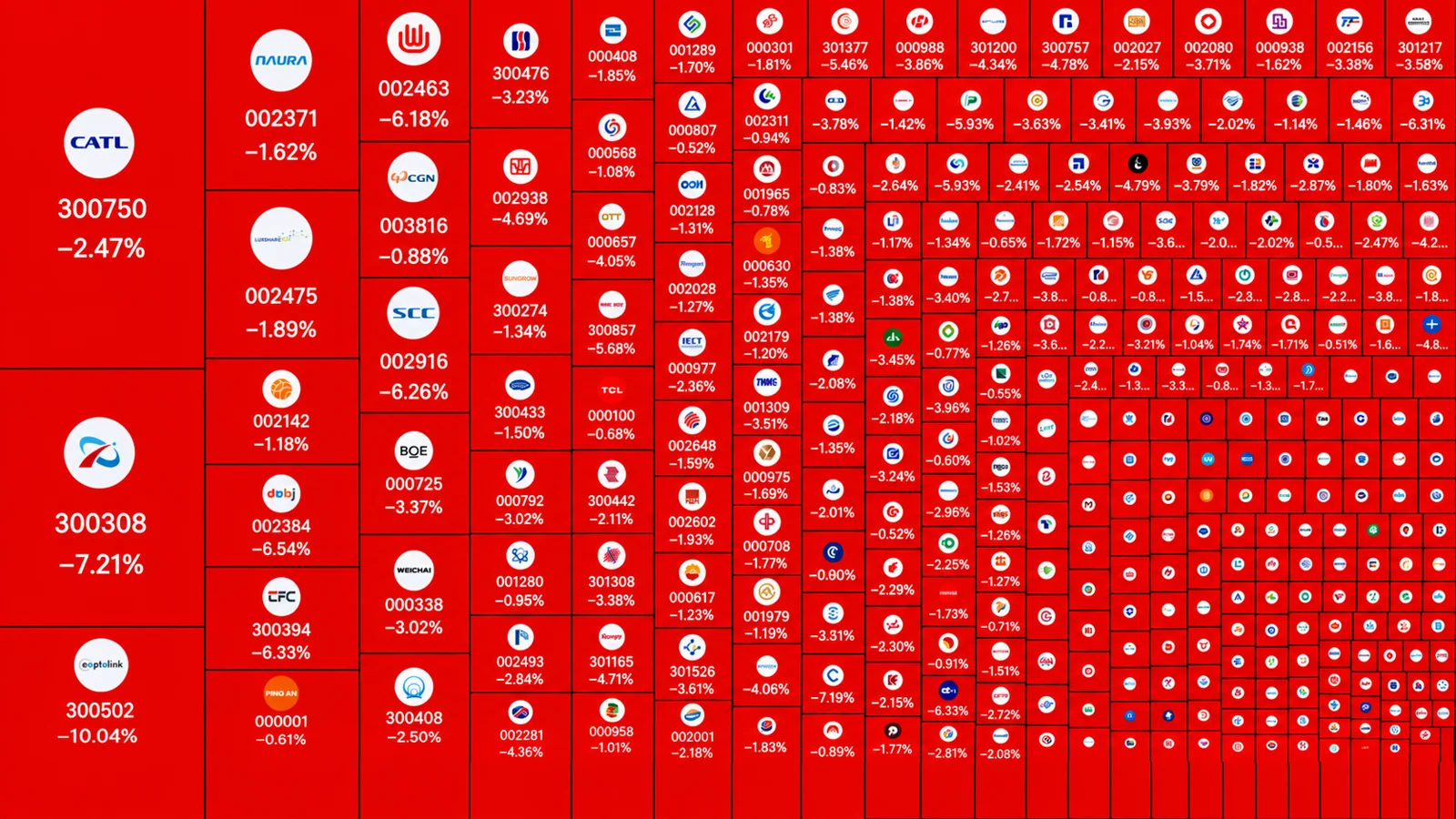
The Nifty 50 index has dropped 5.0% since 22 June, to 22,888.9 on 19 October. China’s Shenzhen Component index has lost 30.6% over the same four months and the Shanghai Composite 12.1%, to 3,658.0. The rupee, at 94.45 per dollar, is 0.3% stronger than it was on 22 June.
Over nearly two decades of monthly data, each 1% fall in the Shanghai Composite has been followed within six months by a 0.65% fall in the Nifty 50 and a 0.21% weaker rupee. Little of it arrives at once: in the month of the fall, the Nifty has given up 0.14% for each 1% in Shanghai. On that path, the Nifty would be 5.8% lower four months on, close to where it stands. The rupee would be 1.6% weaker.
The gap matters because the rupee is where China’s slump lands on Indian balance sheets. Foreign-currency borrowing registered with the Reserve Bank of India is spread across 4,246 Indian borrowers, and ten of them hold 36% of it. Reliance Industries alone holds 8.2%. Five of the ten are owned by the state and together hold 17.9%: REC, Power Finance Corporation, Indian Railway Finance Corporation, the Export-Import Bank of India and NTPC.
Foreign money has not held it. Foreign portfolio investors sold a net ₹49,870 crore of Indian shares between 1 and 21 October, about $5.2 billion, NSDL data show. That is the channel through which a stock slump usually reaches the rupee, and it is open. The currency has held while the central bank manages its swings.
Where the cost lands
A weaker rupee raises the rupee cost of every dollar of debt that is not hedged. For REC and Power Finance Corporation, that cost sits inside their loans to state power utilities. For Indian Railway Finance Corporation, it sits inside the lease payments of Indian Railways. For the Export-Import Bank, it sits inside credit to exporters. At the end of the chain are the power consumer, the railway budget and the exporter’s cost of finance.
| Borrower | Share of India’s registered foreign-currency debt |
|---|---|
| Reliance Industries | 8.2% |
| REC | 4.0% |
| Indian Railway Finance Corporation | 3.9% |
| Power Finance Corporation | 3.9% |
| Reliance Jio Infocomm | 3.7% |
| Export-Import Bank of India | 3.4% |
| NTPC | 2.7% |
| Shriram Finance | 2.4% |
| ArcelorMittal Nippon Steel India | 2.1% |
| InterGlobe Aviation | 1.9% |
| The ten together | 36.2% |
Still, the pattern has been looser since 2023, as China’s market has explained less of India’s moves than it did before, and in the same month the two markets barely move together. Reliance Industries, the largest borrower, also earns dollars from fuel exports, which offsets part of its cost. And there is no dependable record of China’s slumps cheapening Brent crude, the channel through which a Chinese slowdown would help India most.
The six-month mark falls on 22 December. On Shanghai’s fall to date, the full pattern comes to 7.9% for the Nifty 50 and 2.6% for the rupee. The Reserve Bank publishes its foreign-exchange reserves each Friday; if it is spending them to hold the rupee, that is where it shows first.
China’s index levels are closes to 22 October; the Nifty 50’s to 19 October. The six-month pattern is measured on monthly data: 226 months for the Nifty 50 and 271 for the rupee. Borrower shares are of registered foreign-currency borrowing; the registrations do not show how much of it is hedged.
Correction, 26 October 2026: an earlier version said foreign portfolio investors put a net $2.1 billion into Indian shares between 28 August and 21 October. NSDL data show they sold a net ₹49,870 crore between 1 and 21 October.