
For an arbitrage desk, the close of trading is a coordination problem. Shares must be bought or sold, the corresponding futures position adjusted, and the difference between the two preserved after costs. A price on a screen is useful only if the required quantities can actually be executed.
India’s closing-auction reform changes that coordination. It creates an opportunity to concentrate liquidity at the benchmark price. It also changes the sequence in which a trader can know the cash price, obtain an execution and finish the hedge. The commercial contest is over who can provide that certainty economically.
The reform began on August 3 for cash-market stocks with listed derivatives. Previously, their closing prices came from the final half-hour’s volume-weighted average. SEBI’s framework instead pools orders into an auction, with order entry from 3:20 p.m. and a random stop between 3:28 and 3:30 p.m. Matching follows; derivatives remain open until 3:40 p.m. One objective is to let passive funds transact at the price used by their benchmark. SEBI’s January circular
A fund trying to match an index close and a desk trying to preserve a cash-futures spread consequently face different incentives. The former values execution at the benchmark. The latter must judge the cost and uncertainty of the whole pair. An auction can serve the first objective while forcing the second business to adapt.
More activity in fewer minutes
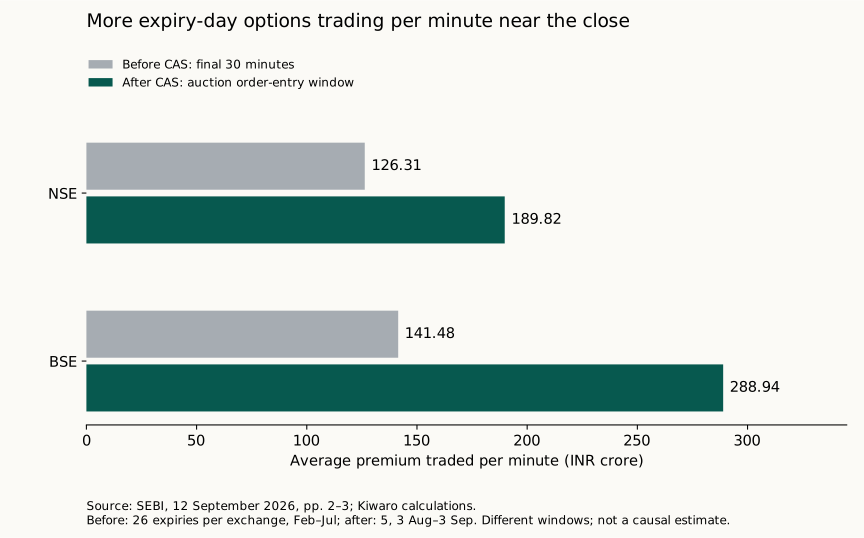
SEBI’s September consultation supplies a striking detail. In its sample of expiring benchmark index options, average premium traded per minute rose from ₹126.31 crore in the old final half-hour to ₹189.82 crore during the auction order-entry window on NSE. BSE’s corresponding figures were ₹141.48 crore and ₹288.94 crore: increases of 50.3% and 104.2%, respectively, calculated by Kiwaro.
The comparison covers 26 expiries per exchange before the change and five afterwards. The windows differ: 3:00–3:30 p.m. before, against 3:20–3:30 p.m. afterwards. These are descriptive rates for index-option premiums, not stock-futures turnover or an estimate of the auction’s causal effect. SEBI consultation, pages 2–3
For institutions, this raises a more useful question than whether activity has simply disappeared: how much trading must be accommodated during the minutes when the cash price is being resolved? A market can trade less over a month yet demand substantial execution capacity at a particular moment. Monthly turnover alone cannot answer whether a hedge will be completed cheaply.
Nor is an indicative auction price an executed cash trade. A desk responding to that indication in futures may still be waiting to learn its final cash allocation. What appears to be a price discrepancy can therefore include compensation for execution uncertainty. That is Kiwaro’s interpretation of the mechanism, rather than a measured estimate of traders’ profits.
The balance sheet tells a different story from turnover
Kiwaro’s calculations from retained NSDL observations show why the measurement matters. Between August 28 and September 30, foreign portfolio investors’ outstanding stock-futures contracts fell 1.5%, while their reported rupee value fell 6.9%. Outstanding index-futures contracts rose 31.9% over those same endpoints.
Those numbers describe FPI positions, not the entire market or domestic arbitrage funds. They span expiry and rollover cycles; rupee values also reflect prices and contract composition. They establish neither migration by the same investors nor an auction-induced withdrawal of capital. The available series contains 20 observation dates, so Kiwaro has used endpoint comparisons rather than presented an incomplete monthly total. NSDL reporting source
The distinction has immediate business consequences. Turnover measures transactions during a period. Open interest measures contracts still outstanding. Neither is an exchange’s revenue, a fund’s assets under management or its realised profit. A decline in the rupee value of open interest cannot be booked as money leaving a strategy.
For a cash-and-carry position, the economic margin is the captured futures premium plus applicable distributions, less financing, taxes, fees and execution costs. A larger displayed spread can be less attractive if one leg becomes more expensive to finish. For intermediaries, changes in transaction volume reach earnings through the actual fee schedule, client mix and costs; notional market value is not fee income.
Cash requirements add another dimension. Futures positions are marked to market daily. A gain on shares held does not automatically supply the cash needed to meet a loss on the short futures leg at the required time. Initial collateral, settlement cash flows and the combined position’s profit must be kept distinct. NSE settlement mechanism
Participation is part of the product
The international comparison suggests that a closing auction’s economic value depends on its surrounding execution arrangements. NYSE reported that US equity closing auctions matched $55.5 billion a day in the second quarter of 2024, representing 9.44% of traded notional value. In August that year, it brought forward the inclusion of Closing D-Orders in its imbalance information by five minutes and reported earlier order submission and faster matching of interest. Those are historical US observations, not forecasts for India. NYSE research
The lesson for India is practical: information about orders, time to respond and access to counterparties are part of what makes the benchmark usable. The auction’s potential advantage grows when more participants can confidently supply the opposite side. If uncertainty keeps those participants away, benchmark-seeking funds may face a more difficult execution problem even though the pricing rule itself is transparent.
This creates a plausible competitive advantage for brokers and trading firms that can demonstrate better completion rates, lower slippage and reliable funding across both legs. It also creates a test for fund buyers: a quoted arbitrage return is incomplete without understanding the costs incurred to capture it. These are commercial implications of the mechanism; comparative firm-level performance has not yet been established.
The next decision reaches beyond the auction
SEBI’s September 12 paper proposed either blending continuous-session and auction transactions into expiry settlement, or initially using the last 30 minutes of continuous trading. It invited comments by October 3. These are proposals, not implemented replacements. Consultation, sections 3 and 7
A settlement rule determines which price a hedge ultimately needs to match. Changing that rule can change when participants want to trade, which institutions can provide the other side and what they must charge for doing so. The next consequential evidence will be the adopted settlement design, followed by actual completion costs, auction participation and fund outcomes under that design.
For an institution, the valuable close is one at which the required trade can be completed on acceptable terms. India’s reform will be judged by how well its benchmark and its execution market work together.
Data note: Calculations use the cited SEBI table and Kiwaro-retained NSDL observations through September 30. Percentages are rounded to one decimal place. This analysis makes no estimate of the reform’s causal effect on market-wide futures turnover or investment returns.