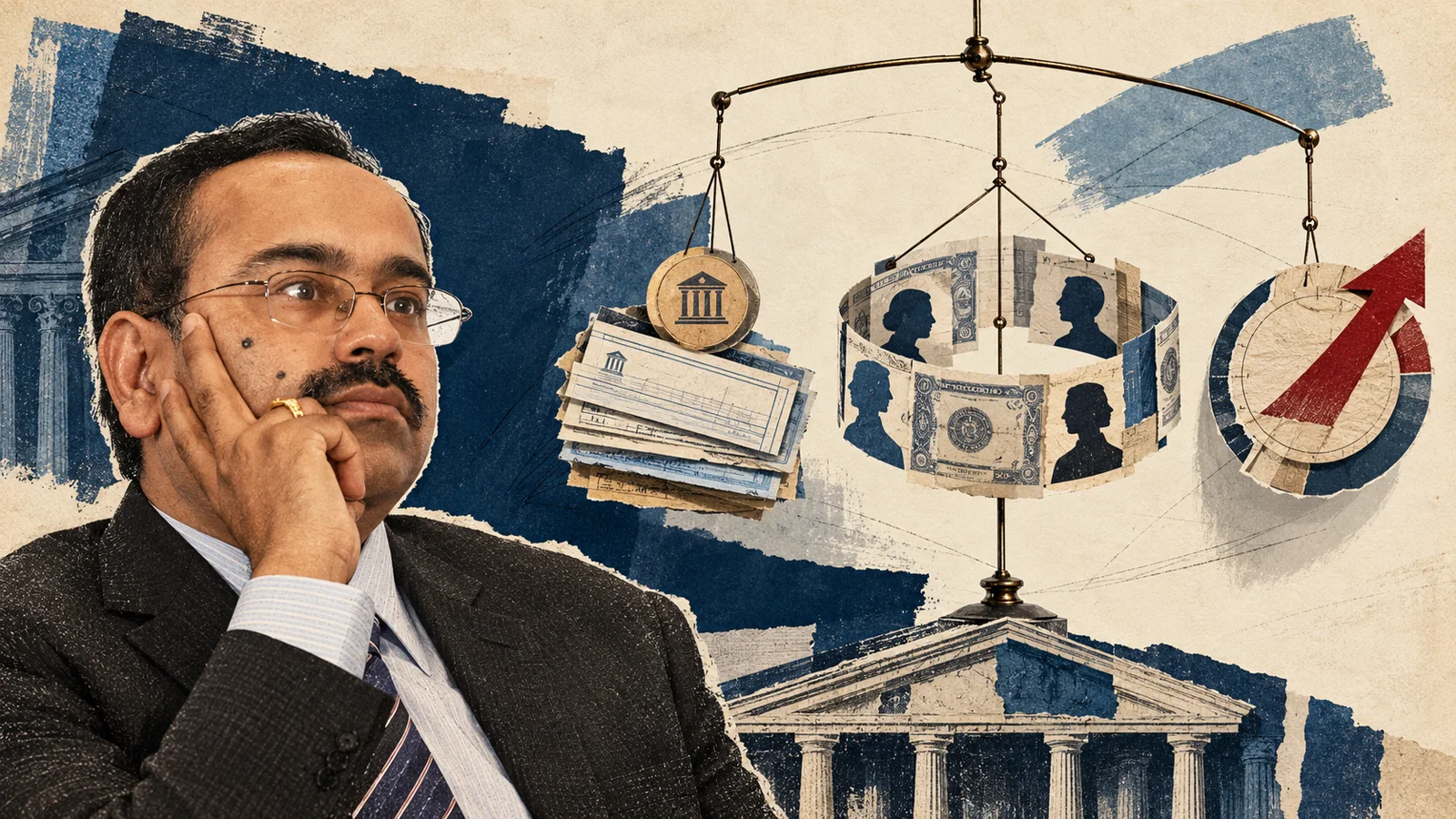
Anup Bagchi took charge of HDFC Bank on 27 October with a balance sheet that is growing far faster than the profit it produces. In the year to September India’s largest private lender increased its loans by 16.4% and its deposits by 18.8%. Its net profit rose 4.7%, to ₹19,510 crore.
"The clear long-term goal is to deliver sustainable long-term value for shareholders, employees and clients," Mr Bagchi told analysts on 17 October, ten days before he succeeded Sashidhar Jagdishan as the first chief the bank has hired from outside.
The filing shows where the gap comes from. Deposits came at a price: 4 of the 18.8 points of growth came through a special window for foreign-currency deposits, which cost more than ordinary savings, and the interest the bank paid rose 8.1%. Bond income fell: profit from the treasury business halved, to ₹2,099 crore from ₹4,213 crore, as yields rose. And net interest income, the bank’s core earnings, grew 9.7%, well behind its loans.
Whether Mr Bagchi can close that gap depends less on strategy than on two prices he does not set: the rate the Reserve Bank charges, and the rate the market pays.
A race between two rates
About 70% of HDFC Bank’s loans carry floating rates, its finance chief, Srinivasan Vaidyanathan, told analysts, so the Reserve Bank’s quarter-point rise to 5.5% on 7 October should reach loan yields by December. He called the costlier foreign-currency deposits "a headwind that will offset" that, and said of the bank’s margin: "I think that it is at the bottom."
The market has moved twice as far as the central bank. The one-year Treasury bill cleared at 6.69% on 28 October, up from 6.18% four weeks earlier, the fastest four-week rise since October 2022. The bank’s floating loans follow the Reserve Bank, which moved a quarter point. Its deposits compete with the market, which moved half a point. Which of the two wins decides whether the margin has bottomed.
What an owner gets
At ₹683.30 on Thursday, HDFC Bank is valued at about ₹10.5 lakh crore, roughly $110bn. That is 13.8 times its profit over the past four quarters and 1.8 times its book value, for a return on equity of about 14%.
Turned upside down, that multiple is an earnings yield of 7.3%. India’s ten-year government bonds yield close to 6.95%. An owner of India’s largest private bank is paid about 0.3 percentage points a year more than a lender to the government, for carrying all of the bank’s risk. That thin cushion is what the new chief has to widen.
Who has been leaving
In the year to June, foreign institutions cut their holding by 7.01 percentage points, to 41.83%, and domestic institutions added 5.96 points, to 41.92%. For a dollar-based investor the sums are worse than the earnings yield suggests. The Federal Reserve held its rate on 28 October with two members voting to raise it, a US ten-year bond pays 5.05%, and the rupee trades near 95.6 to the dollar in futures. Indian mutual funds, which now hold 30.62% of the bank, carry no currency loss. One index fund, the SBI Nifty 50 ETF, holds 7.48%.
What the filing also shows
Credit is not the problem. Gross bad loans fell to 1.11% of loans from 1.24% a year earlier, and provisions rose only 2.1%. Growth is using capital: the capital adequacy ratio slipped to 18.87% from 19.96%. Borrowings fell 4%, to ₹4,89,018 crore, and loans equalled 96% of deposits, up from 94.6% in March. The bank is also an owner in its own right, of 74.12% of HDB Financial Services, 52.34% of HDFC Asset Management and 50.54% of HDFC Life.
What to watch
Three numbers will tell. The first is the margin in the December quarter, when the repo rise reaches the floating book and the foreign-currency deposits cost a full quarter. The second is deposit growth against loan growth, now 18.8% and 16.4%. The third is the one-year Treasury bill, now 6.69%.
Mr Bagchi has inherited a bank that grows. His job is to make it earn.