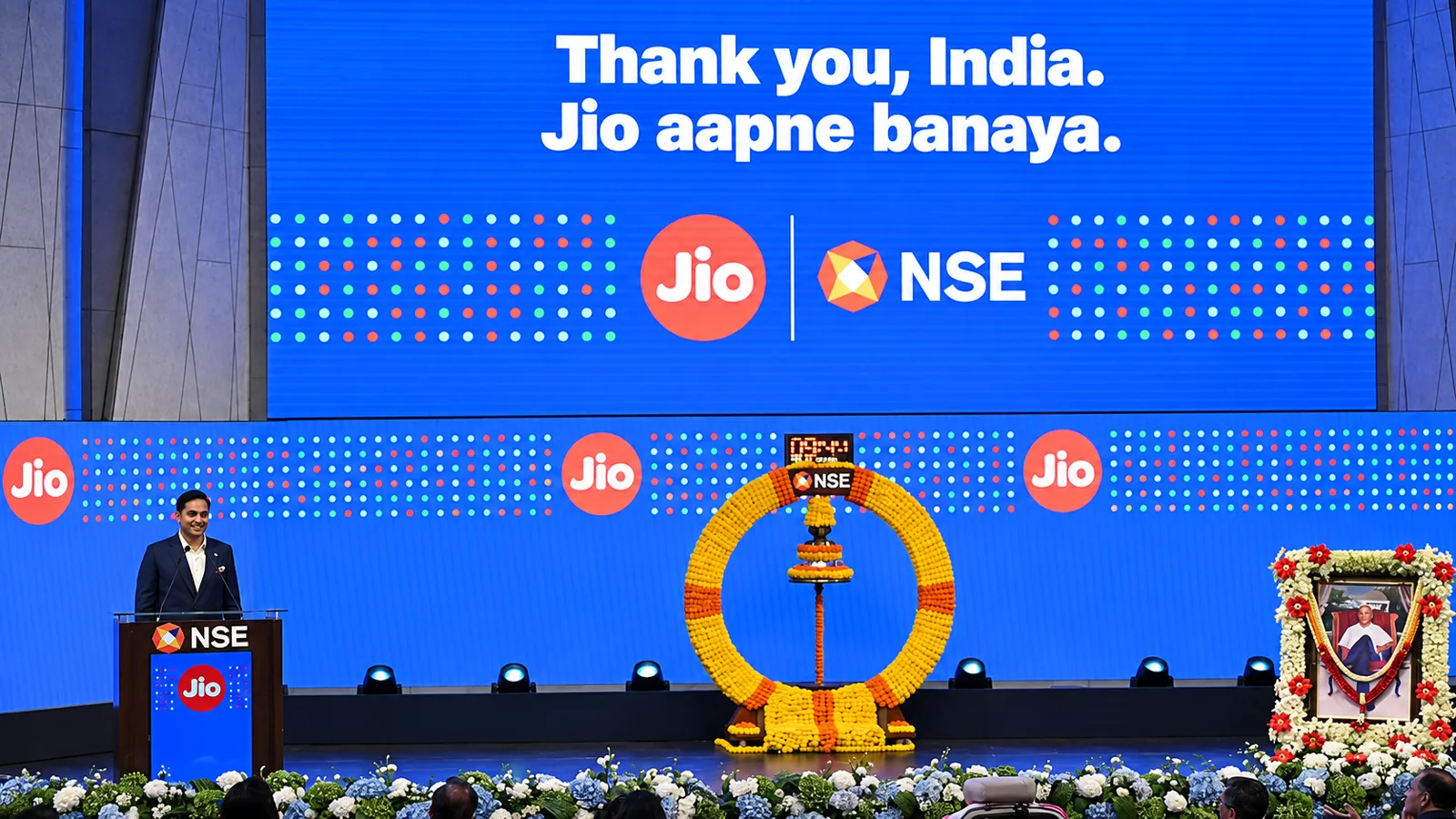
At ten o’clock on Wednesday morning the screen above the stage at the National Stock Exchange read, in two languages, "Thank you, India. Jio aapne banaya." Jio, you built it. A moment later India’s investors said what they thought it was worth. The first trade in Jio Platforms went through at ₹1,358, 21.4% above the ₹1,119 the company had asked, and by lunchtime one of every five rupees changing hands on the exchange was changing hands in Jio.
That is the day in one sentence, and it hides three stories. The market priced Jio in about half an hour and then stopped arguing. It priced Jio on Jio’s terms, paying no attention to anything else on the screen. And the one company that paid for the celebration was the one that threw it.
Half a century, then 95 minutes
Reliance Industries sold its first shares to the public in 1977, when Dhirubhai Ambani ran a textiles business and a share certificate with his name on it was an act of faith for the small investors who took one. On Wednesday his grandson Akash stood at the exchange to list the company the family built on top of all that. Mukesh Ambani, Reliance’s chairman, wept. His daughter Isha said the issue renewed her grandfather’s trust with investors. Akash said the listing left Jio with a greater responsibility, and promised value for decades.
The money had already voted. Jio raised ₹30,213 crore, the largest share sale in India’s history, selling 27 crore new shares at the top of a ₹1,065 to ₹1,119 range. The offer was fully subscribed in 95 minutes and drew more than a crore of applications. Not a rupee of it goes to Reliance; all of it is earmarked to pay down the debt of Jio’s telecom arm. That matters for what came next. The parent sold nothing, and by lunchtime it was poorer anyway.
One stock, a fifth of the market
Then trading opened, and the crowd that had queued for the offer came back for the shares. By 11:49 am, ₹16,761 crore of Jio stock had changed hands on the National Stock Exchange, more than the next ten most-traded stocks put together, which managed ₹9,692 crore between them. By 1:31 pm Jio’s tally was ₹17,775 crore out of ₹88,754 crore traded across 3,553 stocks: a fifth of the market, and still more than the ₹13,965 crore that went through the next ten, a list that included Reliance itself, HDFC Bank, Infosys and Larsen & Toubro.
For everyone else on the exchange, that is what a listing this size feels like: the room empties. Measured by how evenly the day’s money was spread, the market traded as if it had 175 active stocks rather than 342. For a few hours one company drew half the market’s attention to itself.
Thirty minutes to a verdict
The crowd came early and decided fast. The first fifteen minutes of trading carried more than forty times the volume of the quarter-hour after one o’clock. Prices jumped around in the first half-hour and then went quiet. Within that half-hour the stock had settled between ₹1,357 and ₹1,374.50, a band of 1.29%, and it stayed there into the afternoon. The average price paid across the day was ₹1,360.84; at 1:31 pm the stock stood at ₹1,360, 21.5% above the issue price.
For the small investors who got an allotment, that is the number that matters: the premium they woke up to held through the morning. For the institutions that bought in the first minutes, it meant they had paid about what everyone paid. The market reached its verdict on Jio in about half an hour and did not revisit it.
On its own terms
What is striking is how little the rest of the market had to do with that verdict. Minute by minute, Jio’s price did not follow the Nifty. When the index dipped, Jio paid no attention; when the banks moved, Jio paid no attention. Reliance, as on any other day, rose and fell with the index. Jio rose and fell with nobody. Draw the day’s trading as a web, linking any two of the market’s big names whenever they moved together, and the index, the banks, the software companies and the telecom stocks all join one cluster. Jio sits outside it, alone.
That is the clearest sign a listing has worked. Jio’s price on Wednesday was set by people deciding what Jio is worth, not by the day’s mood. For a portfolio, a stock like that is not more of the same; it is something new.
The parent’s bill
The market’s mood, for the record, was calm. The Nifty 50 was 0.11% lower at 22,724.70 at 1:31 pm, and more stocks rose than fell, 1,980 against 1,463. The cost of the day landed on one name. Reliance Industries, which controls Jio, was 2.50% lower. Allow for what the market’s own small dip explains, and Reliance fell about 2.36% further than it should have. In the past year it had had a day that bad, relative to the market, only five times.
One reading is simple. Until Wednesday, anyone who wanted a piece of Jio had to own Reliance to get it. Now they can own Jio. Some of the money that used to go to the parent for the sake of the child went straight to the child.
Jio’s rivals, for their part, took the day in stride. Bharti Airtel, Vodafone Idea, Indus Towers and Tata Communications all slipped, but no further than on an ordinary day. Jio Financial Services, the group’s other listed offshoot, barely moved. The day’s other big moves had nothing to do with Jio: software stocks fell 1.94% as a group, Infosys with them, while HDFC Bank rose.
Ahead of the analysts
The market also outran the people paid to value it. Three brokers began covering Jio on its first day: Nomura, Motilal Oswal and Elara. Nomura called it the "disruptor now the leader" and set a target of ₹1,340. The stock passed that level with its first trade and never looked back; its lowest trade of the day was ₹1,357. Motilal Oswal’s target was overtaken on debut as well.
What investors paid for is a very large business that is still growing. In the year to March 2026 Jio took in about ₹1.47 lakh crore of revenue, 14.6% more than the year before, and kept about 52 paise of every rupee as operating profit before depreciation. AT&T, for comparison, kept about 37 cents of every dollar in 2025. Jio’s net profit was about ₹30,000 crore. Each of its users paid it about ₹214 a month, which is where the long argument about Indian telecom valuations begins: a vast number of customers, each paying very little. Within hours of its debut the market had made Jio India’s second most valuable company and pushed Tata Consultancy Services out of the top five, the biggest first-day gain among the country’s five largest share sales.
Akash Ambani has already said where the next decade goes: AI, cloud and space technology.
Who won, who paid
By early afternoon the ledger was clear. Jio’s new shareholders owned a stock worth 21.5% more than they paid for it in the offer, in a business earning about ₹30,000 crore a year. Reliance’s shareholders owned a prized subsidiary at a public price for the first time, and had paid for the privilege with one of the parent’s worst days of the year relative to the market. Everyone else on the exchange had spent a morning in a market whose breadth one stock had halved. And the market itself had done something it rarely gets to do: take a company worth more than almost any other in the country, price it from scratch in half an hour, and price it on its own terms.
Nearly half a century after Dhirubhai Ambani asked the public to trust him with its savings, his grandson’s company drew a fifth of India’s stock market in a day. The market said yes, quickly, and then turned to ask what it meant for the company that built it.